

Why every war thinks it'll be different, and isn't
Part I: Before the War Begins

Author’s note: This article is divided into two parts. Part I explores the first two strategic illusions that shape decisions before war begins. Part II examines the remaining three, showing why military victories often fail to deliver the political outcomes governments expect.
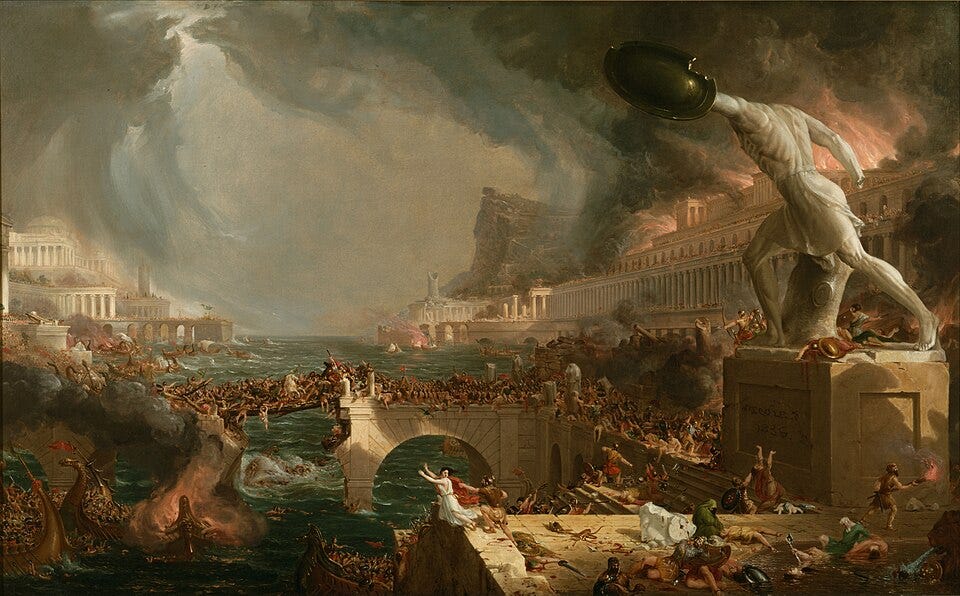
On the morning of August 1, 1914, crowds gathered outside Berlin’s railway stations to cheer as young men boarded trains bound for the front. Newspapers spoke of duty and victory, flowers were tucked into rifle barrels. Across Germany, and indeed much of Europe, the prevailing mood was not one of dread, but of confidence. Few imagined they were witnessing the beginning of a conflict that would kill an estimated 20 million people, redraw the political map of Europe, and leave scars that shaped the rest of the twentieth century.
The optimism was not uniquely German. In France, the offensive spirit of élan vital fostered confidence that determination and rapid maneuver could overcome the enemy. In Russia, military mobilization was expected to deter aggression as much as prepare for it. Even in Britain, where policymakers anticipated a longer struggle than many on the continent, few foresaw the years of industrialized stalemate that would define the Western Front. Nearly every major power entered the war believing that it understood the conflict better than its adversaries. Nearly every major power proved wrong.
When the United States escalated its involvement in Vietnam during the 1960s, many officials believed that overwhelming military superiority would eventually compel North Vietnam to negotiate. In December 1979, Soviet leaders expected their intervention in Afghanistan to stabilize a friendly government through a limited deployment of force. Before the 2003 invasion of Iraq, senior American officials anticipated that Saddam Hussein’s regime would collapse quickly and that post-war reconstruction would proceed far more smoothly than many outside experts predicted. In February 2022, U.S. and European intelligence assessments suggested that Russia expected Kyiv to fall within days, anticipating a rapid collapse of the Ukrainian government rather than a prolonged war of attrition.
Yet beneath these conflicts lies a strikingly familiar pattern. Governments repeatedly convince themselves that the next war will avoid the mistakes of the last. This is not because governments fail to study history. Modern states invest enormous resources in understanding past wars. Military academies devote years to historical campaigns. Intelligence agencies produce detailed assessments of previous conflicts. Strategic planners read Clausewitz, analyze Vietnam, revisit Iraq, and debate Afghanistan. Rarely does a nation enter war believing it has learned nothing from those who came before.
States repeat history because they believe their circumstances are exceptional. Each conflict is presented as politically unique, technologically unprecedented, or strategically unlike anything that came before. Historical lessons are acknowledged, but often explained away as products of another era, another adversary, or another set of conditions.
Robert Jervis: decision-makers do not respond to the world exactly as it is; they respond to the world as they perceive it.
Intelligence is interpreted through existing beliefs, institutional cultures, and political expectations. Evidence that confirms those expectations is often given greater weight than evidence that challenges them. The result is not irrationality, but a systematic tendency toward strategic overconfidence, a pattern that has shaped decisions in democracies and dictatorships alike.
This article is not about why wars begin. Historians and political scientists have debated that question for generations, offering explanations that range from power transitions and alliance systems to ideology, nationalism, and economic interests. Instead, we ask:
Why do governments, despite possessing more information, better intelligence, and centuries of historical experience, continue to make many of the same strategic assumptions before going to war?
Illusion One: The Enemy Will Break First
In June 1812, Napoleon Bonaparte led what was then the largest army Europe had ever seen across the Niemen River and into the Russian Empire. More than 600,000 soldiers from across France and its allied states formed the Grande Armée, a force so formidable that few doubted it could defeat the Russian military. Napoleon had spent more than a decade dismantling Europe’s great powers one by one. Austria had fallen. Prussia had been humbled. Russia, many believed, would be no different.
The campaign unfolded almost exactly as Napoleon expected, at first. Russian forces retreated rather than offering the decisive battle he sought. The French occupied Moscow in September after the bloody Battle of Borodino, seemingly achieving the symbolic victory that had eluded previous invaders. Yet the triumph quickly proved hollow. The city had largely been abandoned, much of it destroyed by fire, and Tsar Alexander I refused to negotiate. As winter approached, Napoleon found himself deep inside hostile territory with overstretched supply lines, dwindling provisions, and an enemy that had chosen endurance over surrender. By the time the remnants of the Grande Armée crossed back over the border, fewer than 100,000 men remained fit for service.
Napoleon had not underestimated Russia’s army. He had underestimated Russia’s willingness to continue fighting after losing its capital.
More than a century later, European leaders made a remarkably similar assumption. Germany’s war plans in 1914 did not depend on overwhelming military superiority alone; they depended on speed. The Schlieffen Plan assumed that France could be defeated rapidly before Russia completed mobilization, allowing Germany to avoid the nightmare of a prolonged two-front war.
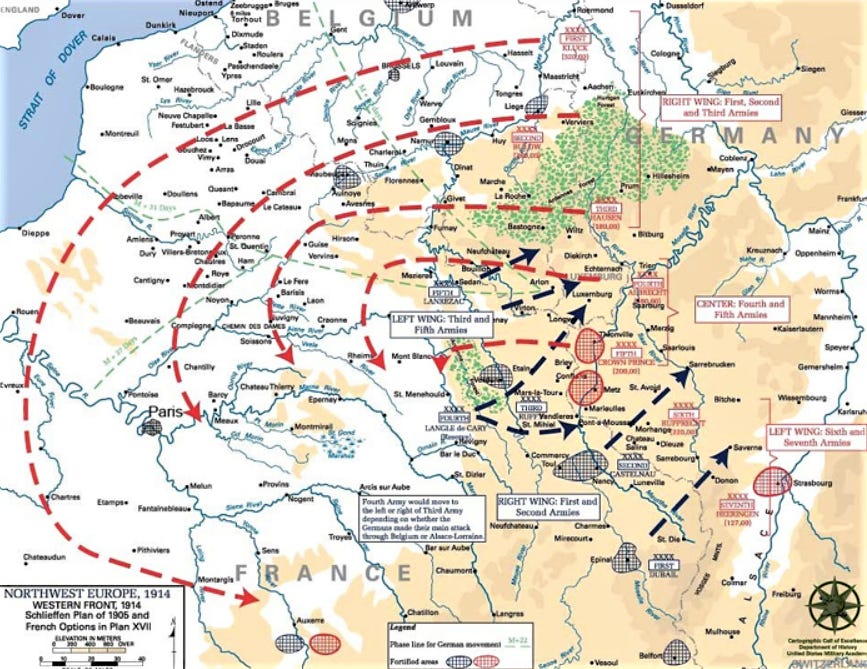
The plan reflected years of meticulous operational planning and careful study of railway timetables, troop movements, and mobilization schedules. It was not irrational. As military historian Hew Strachan notes, German planners believed they were responding logically to the strategic constraints imposed by geography and alliances. What they could not accurately predict was how quickly events would escape their control.
Belgian resistance slowed the German advance. Britain’s entry into the war altered the strategic balance. French forces regrouped along the Marne. Russian mobilization proceeded faster than anticipated in East Prussia. Within weeks, the expectation of a swift campaign had dissolved into entrenched positions stretching from the North Sea to Switzerland. The war Germany expected to finish in months became a conflict of industrial attrition lasting more than four years.
Looking back, what made the July Crisis so catastrophic was not that European governments sought a continental war, but that they believed they could control one. As Christopher Clark demonstrates in The Sleepwalkers, leaders repeatedly treated escalation as something that could be managed, until the crisis escaped everyone's control.
The same pattern reappeared during the Vietnam War, although in a very different form.
American policymakers did not believe North Vietnam possessed superior military capabilities. On virtually every measurable indicator, economic output, industrial capacity, air power, naval strength, logistics, and technology. The United States enjoyed overwhelming advantages, yet American strategy rested on an assumption that proved difficult to quantify: that sustained military pressure would eventually erode Hanoi’s political will.
Internal policy papers reproduced in the Pentagon Papers repeatedly describe bombing as an instrument of "graduated pressure" rather than outright destruction. The Johnson administration expected that progressively increasing air strikes would demonstrate American resolve, convince Hanoi that the costs of continuing the war would become intolerable, and encourage negotiations before the conflict required further escalation. North Vietnam responded differently. Instead of reconsidering its objectives, it dispersed industry, expanded supply routes through Laos and Cambodia, accepted heavy losses, and treated endurance itself as a strategic advantage. The central assumption behind Rolling Thunder, that calibrated military pressure would alter political decision-making in Hanoi—never materialized.
Firepower was never the decisive variable. The two sides simply understood victory differently.
Years later, Robert McNamara would write that the United States had "fundamentally misunderstood" the political forces driving its opponent. Washington viewed the conflict primarily through the lens of Cold War containment, while Hanoi framed it as a struggle for national reunification and independence. Those competing interpretations produced very different calculations about acceptable costs and acceptable losses.
A similar misjudgment shaped the Soviet intervention in Afghanistan. Early Politburo discussions framed the operation as a limited effort to stabilize the communist government in Kabul rather than the beginning of a prolonged war. That expectation steadily unraveled. In a Politburo meeting on 13 November 1986, Mikhail Gorbachev conceded that the Soviet Union had been fighting in Afghanistan for years "with no end in sight," warning colleagues that the conflict could not continue indefinitely. By then, Soviet forces were locked in a costly war against decentralized resistance groups that adapted to the country's terrain, benefited from extensive foreign assistance, and drew strength from local networks beyond the reach of conventional military power.
More recently, Russia’s full-scale invasion of Ukraine has revived many of these debates. Although much about Russian decision-making remains classified, Russia's opening campaign toward Kyiv reflected expectations of a rapid political collapse. Ukrainian institutions did not collapse. President Volodymyr Zelensky remained in the capital, military units reorganized under intense pressure, and civilian resistance expanded across the country. Whether these expectations resulted from flawed intelligence, institutional incentives that discouraged dissent, or political overconfidence continues to be debated. What is far less contested is that assumptions regarding Ukraine’s resilience proved profoundly inaccurate.
These wars differed enormously in their causes, participants, and outcomes. Napoleon sought continental dominance. Germany fought within a rigid alliance system. The United States intervened to contain communism. The Soviet Union aimed to preserve a client regime. Russia pursued objectives tied to its broader security and geopolitical claims. Reducing these conflicts to a single explanation would ignore their complexity.
Yet governments consistently found it easier to estimate what an enemy possessed than what an enemy would endure.
Military capabilities can be counted. Satellites reveal troop concentrations. Intelligence agencies estimate production capacity, missile inventories, and logistical networks with increasing sophistication. Political resilience is different. It depends on leadership, national identity, public legitimacy, social cohesion, historical memory, and countless other factors that cannot be measured with the same precision.
Robert Jervis argued that states rarely act on objective reality alone. They act on their perception of reality, a perception shaped by prior beliefs, institutional cultures, and expectations about how adversaries are likely to behave. Once leaders become convinced that an opponent is weak, divided, or nearing collapse, contradictory evidence often receives less attention than information confirming the original judgment. Even accurate intelligence can become misleading when interpreted through assumptions leaders already expect to be true.
History does not suggest that governments always underestimate their enemies. There are notable exceptions. Coalition planners before the 1991 Gulf War accurately anticipated that Iraq’s conventional forces would struggle against the technological and operational advantages of the U.S.-led coalition. During the Second World War, Allied planners increasingly developed sophisticated assessments of German industrial capacity and military production that informed long-term strategy with considerable accuracy.
Intelligence remains indispensable. Its greatest limitation appears when governments attempt to forecast something far less tangible than troop numbers: political resolve.
Wars are fought with armies, tanks, aircraft, and artillery. They are sustained, or abandoned, by political decisions, public will, and the willingness of societies to continue paying the price of conflict. Those are variables no intelligence service has ever measured with complete certainty.
Illusion Two: Technology Will Change the Rules
In 1921, the Italian general Giulio Douhet published The Command of the Air, a book that would profoundly shape military thinking for decades. Air power, in Douhet's view, had fundamentally changed the nature of war. Instead of grinding campaigns fought across trenches and battlefields, future conflicts could be decided from the sky. Strategic bombing would destroy an enemy’s industry, shatter civilian morale, and compel governments to surrender before costly land campaigns became necessary.
Douhet captured an idea that was spreading rapidly across military circles.
Across Europe and the United States, military theorists embraced the idea that technological innovation had finally broken the stalemate that defined the First World War. Aircraft promised mobility where trenches had produced paralysis. Radio transformed command and control. Mechanized formations offered speed unimaginable only a generation earlier. Technology, many believed, had solved the problems that history had exposed.
The appeal was obvious. The First World War had demonstrated the horrifying cost of industrial warfare. If new technologies could shorten future conflicts, they would not only deliver military victory but spare societies another generation of mass slaughter. The search for a decisive weapon became one of the defining strategic pursuits of the twentieth century. History, however, proved considerably less accommodating.
During the Second World War, Allied and Axis powers invested enormous resources in strategic bombing campaigns under the belief that destroying industrial centres and civilian infrastructure would break an opponent’s capacity, or willingness, to continue fighting. Cities from London to Dresden, Hamburg, Tokyo, and dozens of others became targets of unprecedented aerial bombardment.
Bombing devastated industrial production, crippled transportation networks, and forced Germany to divert vast resources toward air defence and reconstruction. The United States Strategic Bombing Survey nevertheless concluded that these effects alone did not bring about Germany's surrender. Their greatest impact came as part of a broader Allied campaign that combined sustained air attacks with the ground offensive, economic blockade, and the progressive collapse of Germany's military position. In the Pacific, the Survey likewise viewed Japan's defeat as the product of cumulative strategic pressures rather than a single technological breakthrough. Air power had transformed warfare, but it had not made strategy obsolete.
Two decades later, confidence had shifted from bombers to a far broader technological arsenal.
By the mid-1960s, the United States possessed one of the most technologically advanced militaries in history. Sophisticated aircraft, helicopters, electronic sensors, precision-guided munitions, and overwhelming firepower created confidence that sustained military pressure could gradually force North Vietnam to abandon its objectives. Campaigns such as Operation Rolling Thunder were designed not simply to destroy targets but to alter political decision-making in Hanoi through carefully calibrated escalation.
During discussions preceding Operation Rolling Thunder, memoranda published in Foreign Relations of the United States reveal that Robert McNamara, McGeorge Bundy, and President Lyndon B. Johnson saw air power as an instrument of graduated pressure. The objective was not simply to destroy targets, but to demonstrate American resolve, steadily increase the costs of continued resistance, and persuade Hanoi to negotiate before the conflict escalated further. North Vietnam answered with a different strategy: dispersing infrastructure, adapting supply routes, and accepting mounting losses in the belief that time favored its position. The United States retained overwhelming technological superiority, but battlefield success never became political success.
Military force can destroy bridges, fuel depots, and command centres. It cannot easily determine how much suffering a government or society is willing to endure before changing its objectives. Carl von Clausewitz, observed nearly two centuries earlier, war is never an end in itself but “a continuation of policy by other means.” Military operations remain inseparable from political purpose, no matter how advanced the weapons employed.
The optimism surrounding precision warfare returned after the 1991 Gulf War.
Images of “smart bombs” appeared to signal a new era in which technology could deliver rapid victories while minimizing civilian casualties and military losses. The coalition’s swift defeat of Iraqi conventional forces reinforced the perception that information technology and precision strike capabilities had fundamentally changed the character of war.
Stephen Biddle cautions against attributing the coalition's success to precision-guided weapons alone. Iraq’s defeat reflected a combination of coalition air superiority, integrated command structures, extensive logistical preparation, overwhelming numerical advantages in key sectors, and an Iraqi military weakened by years of war with Iran. Technology amplified these strengths; it did not independently create them.
The campaigns in Afghanistan and Iraq initially appeared to confirm those expectations.
Coalition forces dismantled conventional military resistance using precision air strikes, satellite communications, unmanned aerial systems, and networked command structures. Initial battlefield victories unfolded far faster than many previous wars. Yet the conflicts themselves did not end with the collapse of opposing armies. Insurgency, political fragmentation, sectarian violence, and state-building replaced conventional manoeuvre as the central challenges of both wars.
Today, many of these debates have re-emerged around drones, autonomous systems, cyber operations, and artificial intelligence. The war in Ukraine has demonstrated both the extraordinary potential and the limitations of new technologies. Commercial drones have transformed battlefield surveillance. Artificial intelligence increasingly assists intelligence analysis and targeting. Satellite imagery provides unprecedented transparency over troop movements. Even so, the battlefield still contains familiar features: fortified defensive lines, artillery duels, logistical attrition, and prolonged struggles over territory.
Every technological revolution changes warfare. None has abolished uncertainty.
Lawrence Freedman describes military history as a succession of innovations capable of overcoming the inherent unpredictability of war. Again and again, new technologies reshape tactics and operational methods. Just as consistently, adversaries adapt. Countermeasures emerge. Doctrines evolve. Advantages narrow. What appears revolutionary in one conflict often becomes routine in the next.
None of this diminishes the importance of technological innovation. States that fail to modernize frequently pay a heavy price. Rather, history suggests a different lesson.
Technology changes how wars are fought far more quickly than it changes why wars are fought, or how they end.
The enduring illusion is believing that technology can substitute for strategy, compensate for flawed political assumptions, or remove the uncertainty that has accompanied every war in recorded history.
Every generation believes it has finally discovered the weapon that will make war decisive. Every generation eventually discovers that the enemy has a vote as well.
Read more here:
ILLUSION ONE
Pentagon Papers: Part IV.C.3 — "The Rolling Thunder Program Begins: January–June 1965."
Pentagon Papers: Part IV.C.7 (a) — "Air War in the North: 1965–1968."
CIA Intelligence Memorandum: Afghanistan: Prospects for the Insurgency (1984)
Politburo Meeting on Afghanistan (13 Nov. 1986)
ILLUSION TWO
United States Strategic Bombing Survey: Reports — European War
United States Strategic Bombing Survey: Reports — Pacific War
Naval History & Heritage Command: Naval Air War — The Rolling Thunder Campaign
RAND: War By Other Means (Iraq War)
Institute For Defense Analysis: Commentary on "Victory Misunderstood” — Stephen D. Biddle
This is such a good point about states thinking their particular war is the exception to history. I always find it wild that the smartest people in the room, generals and diplomats who've read all the same books we have, still fall into the same trap. Geez. You'd think Napoleon's Russia disaster would be required reading before anyone even thinks about a winter campaign. Thanks for writing this!